

Hey there! As a supplier of double helix gears, I've been deeply involved in the world of these amazing mechanical components. One question that often pops up in discussions with customers and industry folks is: What is the influence of the material hardness on double helix gear performance? Well, let's dive right in and explore this topic.
First off, let's understand what double helix gears are. They're a type of gear that combines the best of both worlds. The double helix design helps to cancel out axial thrust forces, which is a huge advantage in many applications. These gears are used in a wide range of industries, from automotive to heavy machinery, and their performance can make or break a system.
Now, onto the main topic - material hardness. Material hardness is a measure of how resistant a material is to indentation, scratching, or wear. In the context of double helix gears, it plays a crucial role in determining their performance and longevity.
Wear Resistance
One of the most obvious effects of material hardness on double helix gear performance is wear resistance. Gears are constantly in contact with each other, and as they rotate, they experience friction and wear. A harder material will be more resistant to this wear, which means the gears will last longer.
For example, if you're using double helix gears in a high - speed application, such as in a racing car transmission, the gears are subjected to a lot of stress. A gear made from a hard material like hardened steel will be able to withstand the constant rubbing and meshing without wearing down quickly. On the other hand, a softer material might start to show signs of wear after just a few hours of operation. This can lead to a decrease in gear efficiency, increased noise, and eventually, gear failure.
Load - Carrying Capacity
Material hardness also affects the load - carrying capacity of double helix gears. Harder materials can handle higher loads without deforming. When a gear is under load, it experiences stress. If the material is too soft, it can deform under the stress, which can cause misalignment and uneven wear.
Let's say you're using double helix gears in a heavy - duty industrial machine, like a large conveyor system. The gears need to be able to transfer a significant amount of power from the motor to the conveyor belt. A hard - faced gear will be able to handle the high torque and load without deforming, ensuring smooth and efficient operation. In contrast, a gear made from a soft material might deform under the load, leading to increased vibration, reduced efficiency, and potential damage to other components in the system.
Noise and Vibration
The hardness of the material can also have an impact on the noise and vibration levels of double helix gears. When gears mesh, there is always some degree of noise and vibration. However, a harder material can help to reduce these unwanted effects.
Harder gears have a more stable surface, which means they mesh more smoothly. This results in less noise and vibration during operation. For instance, in a precision machinery application, such as a high - end watch or a medical device, low noise and vibration are essential. Using double helix gears made from a hard material can help to achieve this, providing a more reliable and quiet operation.

Fatigue Resistance
Another important aspect is fatigue resistance. Gears are subjected to cyclic loading, which means they experience repeated stress over time. A hard material has better fatigue resistance, which means it can withstand more cycles of loading without cracking or failing.
In applications where the gears are used continuously, like in a power generation plant, fatigue resistance is crucial. A gear made from a hard material will be able to endure the long - term cyclic loading without developing fatigue cracks, ensuring the reliability and safety of the system.
The Role of Heat Treatment
Heat treatment is a common method used to increase the hardness of gear materials. By heating the gear to a specific temperature and then cooling it at a controlled rate, the material's microstructure can be altered, resulting in increased hardness.
For example, quenching and tempering are two common heat - treatment processes. Quenching involves rapidly cooling the heated gear in a liquid, which causes the material to harden. Tempering is then used to relieve the internal stresses created during quenching and to improve the gear's toughness.
However, it's important to note that heat treatment needs to be carefully controlled. Over - hardening can make the gear brittle, which can lead to sudden and catastrophic failure. So, finding the right balance is key.
Real - World Examples
Let's take a look at some real - world examples to illustrate the influence of material hardness on double helix gear performance.
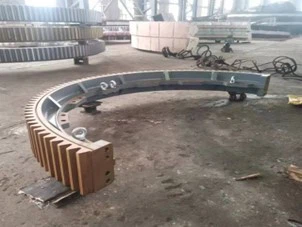
In the mining industry, Sag Mill Girth Gear are used to drive large mills. These gears are subjected to extremely high loads and harsh operating conditions. Gears made from hard - faced materials are preferred because they can withstand the heavy wear and high torque. The hard - faced Girth Gear and Pinion ensure the efficient operation of the mill, reducing downtime and maintenance costs.
In the automotive industry, double helix gears are used in transmissions. The gears need to be able to handle the high - speed rotation and varying loads. A hard - treated gear in a transmission will provide better performance, longer service life, and smoother shifting.
Considerations for Gear Design
When designing double helix gears, the material hardness needs to be carefully considered. The application requirements, such as load, speed, and operating environment, will determine the appropriate material hardness.
For high - speed, low - load applications, a moderately hard material might be sufficient. However, for high - load, high - stress applications, a very hard material will be necessary. Additionally, the cost of the material and the manufacturing process also need to be taken into account.
Conclusion
In conclusion, the material hardness has a significant influence on double helix gear performance. It affects wear resistance, load - carrying capacity, noise and vibration levels, fatigue resistance, and more. By choosing the right material hardness and using appropriate heat - treatment processes, we can ensure that double helix gears perform at their best and last for a long time.
If you're in the market for high - quality double helix gears, we're here to help. Our team of experts can assist you in selecting the right material and design for your specific application. Whether you need Girth Gear Machining for a large - scale industrial project or precision gears for a small - scale application, we've got you covered. Feel free to reach out to us to start a discussion about your gear requirements.
References
- "Gear Design and Application" by Dudley, Darle W.
- "Mechanical Engineering Design" by Shigley, Joseph E.
- "Materials Science and Engineering: An Introduction" by Callister, William D.