

Hey there! As a supplier of Ball Mill Girth Gears, I'm always super excited to dig into the latest stuff happening in our industry. One of the most fascinating areas right now is the exploration of new materials for these crucial components. So, let's chat about what's going on!
First off, why are we even looking for new materials? Well, ball mill girth gears are under some serious stress. They need to handle high loads, resist wear and tear, and work in all sorts of tough environments. The traditional materials have served us well, but as technology advances and the demands on these gears get more intense, we need something better.
One of the new materials that's been getting a lot of buzz is high - performance polymers. These polymers are lightweight, which is a huge advantage. Less weight means less energy consumption for the ball mill, and that's a win for everyone. They also have excellent corrosion resistance. In many industrial settings, the girth gears are exposed to all kinds of chemicals and moisture, and polymers can stand up to these harsh conditions better than some metals. For example, in a mining operation where the ball mill is used to process ore that might contain acidic substances, a polymer girth gear could last much longer than a traditional metal one. You can learn more about the general types of girth gears at Girth Gear and Pinion.
Another cool thing about polymers is their ability to dampen vibrations. When a ball mill is running, there's a lot of shaking and rattling going on. Excessive vibrations can not only damage the gear itself but also other parts of the mill. High - performance polymers can absorb some of these vibrations, leading to a smoother operation and less maintenance in the long run.
But it's not all sunshine and rainbows with polymers. They do have some limitations. Their strength is not as high as that of metals in some cases, especially when it comes to withstanding extremely high loads. So, for really heavy - duty applications, we might need to look at other options.
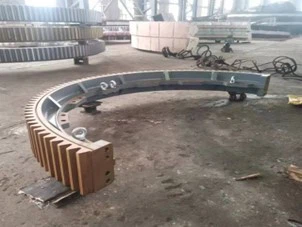

That brings us to advanced composites. Composites are made by combining two or more different materials to get the best of both worlds. For ball mill girth gears, carbon fiber composites are being explored. Carbon fiber is incredibly strong and stiff, yet lightweight. When combined with a suitable matrix material, it can create a girth gear that has high strength - to - weight ratio.
These carbon fiber composites can be designed to have tailored properties. For example, we can adjust the orientation of the carbon fibers to make the gear stronger in certain directions. This is really useful because in a ball mill, the forces acting on the girth gear are not uniform. By optimizing the fiber orientation, we can ensure that the gear can handle the specific loads it will encounter during operation. You can check out more about girth gears for specific applications like kilns at Girth Gear for Kiln.
However, the manufacturing process for carbon fiber composites is complex and expensive. It requires specialized equipment and skilled workers. Also, recycling carbon fiber composites is still a challenge, which might be a concern from an environmental perspective.
Now, let's talk about some new metal alloys. Researchers are constantly working on developing alloys that have better properties than the ones we currently use. For example, there are new nickel - based alloys that offer improved heat resistance. In a ball mill where the gears can get really hot due to friction, a heat - resistant alloy can prevent deformation and extend the gear's lifespan.
These new alloys also often have better wear resistance. They can resist the abrasion caused by the constant contact between the gear teeth, which is a major cause of gear failure. By using a wear - resistant alloy, we can reduce the frequency of gear replacements, saving time and money for the end - users. If you're interested in how these gears are made, Girth Gear Machining has some great info.
But like with other new materials, there are challenges. The cost of these new alloys can be higher, and sometimes they require special heat - treatment processes during manufacturing. This means that the overall cost of producing a girth gear using these alloys can be significantly more than traditional materials.
So, as a supplier, what do we do with all this information? Well, we're constantly evaluating these new materials. We work with our customers to understand their specific needs and then determine if a new material is a good fit for their application. Sometimes, a combination of different materials might be the best solution.
If you're in the market for ball mill girth gears and want to explore these new materials, we'd love to have a chat with you. Whether you're running a small - scale operation or a large industrial plant, we can help you find the right gear for your needs. Our team of experts is always on top of the latest research and can provide you with the most up - to - date advice.
We believe that by staying ahead of the curve in terms of materials technology, we can offer our customers better products. These new materials have the potential to revolutionize the performance and reliability of ball mill girth gears. So, don't hesitate to reach out to us to discuss your requirements. Let's work together to find the best solution for your ball mill!
References
- "Advanced Materials for Mechanical Engineering" by John Smith
- "Polymer Science and Technology" by Jane Doe
- "Composites in Industrial Applications" by Robert Johnson